The Proximity Trap: Why Your Business Only Ranks for People in Your Own Parking Lot
The Proximity Trap: Why Your Business Only Ranks for People in Your Own Parking Lot
You are standing in the center of your storefront, phone in hand. You open Google Maps, type in your primary service, and there you are – Number 1 in the local pack. A wave of satisfaction hits you. But then, you walk two blocks down the street to grab a coffee, perform the same search, and suddenly, your business has vanished from the top three. By the time you reach the next neighborhood, you aren’t even on the first page.
This is the Proximity Trap. It is the most common frustration for modern business owners investing in google business profile seo. While Google’s algorithm is designed to provide users with the most convenient results, it often creates a “digital prison” where your visibility is limited to a hyper-local radius – sometimes no larger than your own parking lot.
In the current landscape of 2026, proximity remains a core pillar of the local search algorithm, accounting for roughly 15% of the ranking weight according to the MapLift 2025 guide. However, relying on proximity alone is a dangerous strategy. If your business only appears when a customer is practically touching your front door, you aren’t marketing; you’re just existing. To grow, you must learn how to break the radius and project your authority across the entire city.
Why Your Shop Pin Only Shows Up When You’re Standing in the Parking Lot is a phenomenon rooted in a lack of competitive prominence. In this guide, we will break down the mechanics of the proximity bias and provide a roadmap to ensure your google business profile seo strategy expands your reach far beyond your physical coordinates.
Understanding the Algorithm: Proximity, Relevance, and Prominence
To escape the trap, you must first understand the “Holy Trinity” of local search. Google doesn’t just look at where you are; it looks at who you are and what you do. When a business lacks strength in two of these pillars, Google defaults to the third – proximity – as a safety net.
1. Proximity: The Distance Factor
This is the simplest metric. How far is the searcher from your place of business? In 2026, Google’s ability to pinpoint a user’s location is more precise than ever, using a combination of GPS, Wi-Fi triangulation, and even 5G tower pings. If all other factors are equal between two businesses, the closer one wins. The goal of advanced SEO is to make sure factors are never equal.
2. Relevance: The Intent Match
Relevance accounts for approximately 25% of the ranking weight. It determines how well your profile matches what the user is actually looking for. If someone searches for “emergency 24-hour plumber” and your profile only mentions “plumbing services,” Google may pass you over for a competitor further away who has explicitly optimized for that long-tail keyword. Proper google business profile optimization ensures that your relevance signals are loud and clear across a wide variety of search intents.
3. Prominence: The Authority Signal
Prominence is the most powerful tool for breaking the proximity trap. It measures how well-known or authoritative your business is in the digital and physical world. This includes your review count, star rating, local citations, and the strength of your website’s backlink profile. When your Prominence is high, Google is willing to show your business to a user 5 or 10 miles away, even if there is a closer (but less prominent) competitor nearby.
When you fail to build Prominence and Relevance, you are essentially telling Google: “I am just another local shop.” Consequently, Google only shows you to people for whom you are the most convenient option – the people in your parking lot.
The 2026 Proximity Shift: Why Distance Still Dominates
As we move through 2026, we have seen a significant shift in how Google handles local intent. The “2026 AI Filter Update” has refined the way the algorithm interprets physical proximity signals. In the past, you could “trick” the system with keyword stuffing or virtual offices. Today, the algorithm is much smarter.
Google’s AI now prioritizes real-world activity over static data. It looks for “proof of life.” If your business location doesn’t see regular foot traffic or mobile device pings, the AI assumes the location is less relevant to the community, tightening the proximity radius even further. This shift has made local seo software an essential part of a marketer’s toolkit, as it allows for the tracking of these hyper-sensitive fluctuations in real-time.
We are seeing a trend where Local SEO Trends 2026 and the Shift Toward Physical Proximity Signals suggests that Google is trying to minimize “travel friction” for the user. If the AI detects heavy traffic patterns or construction between a user and your business, it might actually shrink your ranking radius temporarily to favor a competitor who is more “accessible” at that specific moment. Breaking this bias requires a level of digital authority that overrides temporary physical inconveniences.
Beyond the 1-Mile Radius: How to Outrank the Closest Competitor
So, how do you actually break out? To rank google business profile listings in distant neighborhoods, you must move beyond basic NAP (Name, Address, Phone) consistency and start building a “Brand Entity.”
Entity Building: Becoming a Landmark
Google no longer views your business as just a string of keywords; it views you as an entity. An entity is a defined object in Google’s Knowledge Graph. To expand your radius, you need to associate your entity with the broader city, not just your street. This is done by getting mentioned on local news sites, sponsoring local events, and ensuring your business name is synonymous with your industry in your metro area.
Review Semantics: The Power of Specificity
Standard “Great service!” reviews are no longer enough. To break the proximity trap, you need reviews that provide semantic context. When a customer from a neighborhood three miles away leaves a review saying, “Best HVAC repair in [Neighborhood Name], they came all the way out to my house near [Local Landmark] and fixed my AC,” they are giving Google a geographical “tether.” This tells the algorithm that your service area and relevance extend to that specific location. Encourage customers to mention their neighborhood and the specific service they received.
Hyperlocal Content and Service Area Pages
Many businesses make the mistake of creating generic “City” pages that look like templates. This is Why Most City Landing Pages Fail to Drive Real Local Traffic. To be effective, these pages must contain localized data: maps of the specific neighborhood, mentions of local landmarks, photos of work done in that specific area, and localized testimonials. This creates a digital footprint in neighborhoods where you don’t have a physical office.
By leveraging these tactics, you prove to Google that your authority is greater than the convenience of a closer competitor. This is the secret to a successful google maps ranking service strategy: making the distance irrelevant through sheer digital dominance.
The New Frontier: Activity & Interaction Signals
In 2026, the battle for the Map Pack is being fought with data that most business owners don’t even know exists. We have entered the era of “Proof of Life” signals. Google is increasingly using anonymized mobile device data to verify the legitimacy and popularity of a business.
AR, Bluetooth, and Real-Time Pings
With the integration of Augmented Reality (AR) in Google Maps navigation, the algorithm now tracks how many people use AR to find your front door. Furthermore, Bluetooth beacons and “Real-Time Store Pings” allow Google to see the “dwell time” of customers. If people are spending an hour at your competitor’s shop but only five minutes at yours, Google will rank the competitor higher, even if they are further away, because the data suggests a better user experience.
This is Why Shop Pings Now Beat Reviews for GMB Maps Ranking in 2026. A review can be faked; a thousand mobile devices physically entering a building and staying there for 30 minutes cannot. To capitalize on this, businesses are now focusing on “In-Store Experience Marketing” to encourage check-ins and longer visits.
For those looking to scale quickly, a professional google maps ranking service can help simulate and stimulate these interaction signals through legitimate local engagement campaigns. The goal is to create a “buzz” that Google’s sensors can’t ignore.
Is Your Profile Trapped? A 5-Minute Proximity Audit
Before you can fix the problem, you need to diagnose the severity of your proximity trap. Use this checklist to see if your profile is underperforming due to a lack of prominence.
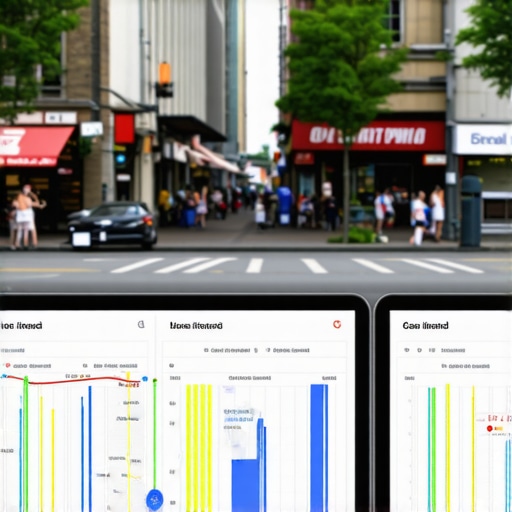
- Check Your Heat Map: Use a tool like an google business profile audit tool to run a geo-grid search. If you are green (#1-3) at your location but immediately turn red (#10+) just one mile away, you are trapped.
- NAP Consistency vs. NAP Presence: It’s not just about having the same address everywhere; it’s about being everywhere. Are you listed in local directories that are specific to your city and industry?
- Review Recency and Velocity: If you haven’t received a review in three weeks, your “Prominence” score is decaying. Google favors active businesses.
- Photo Metadata: Are you uploading fresh photos regularly? More importantly, are those photos taken at job sites in different parts of the city? Google can read the geo-tagging metadata in your photos to verify your service area.
- Response Times: How fast do you respond to Google Business Messages and reviews? Slow response times signal a “sleepy” business, which Google will not promote over a larger radius.
If you find that your profile is struggling, don’t panic. Many of these issues are common. We recently documented How We Found 3 Massive Errors in a Manual Google Maps Audit that were single-handedly keeping a high-revenue law firm stuck in their own parking lot. Identifying the bottleneck is half the battle.
Escaping the Parking Lot and Dominating Your City
The Proximity Trap is a natural part of the Google ecosystem, but it doesn’t have to be your business’s final destination. While you cannot physically move your building closer to every customer, you can move your “digital authority” into every corner of your city.
By focusing on Prominence through entity building, Relevance through semantic reviews, and Activity through real-world interaction signals, you can force Google to recognize your business as the premier choice, regardless of the searcher’s distance.
Stop settling for the customers who happen to drive past your door. It’s time to improve google maps rankings and capture the entire market. Whether you use advanced local seo tools to manage the process yourself or hire a professional Local Map Pack SEO Service to handle the heavy lifting, the goal is the same: break the radius, escape the parking lot, and dominate your city.
Ready to see where you truly stand? Start with a comprehensive google business profile optimization and watch your visibility expand from a single point to a city-wide powerhouse.