
Why Most Law Firms Fail to Show Up for Local Searches
Why Most Law Firms Fail to Show Up for Local Searches (and How to Fix It)
The numbers are staggering and, frankly, an indictment of the current state of legal marketing. In a recent comprehensive analysis of 2,847 legal websites, a chilling reality emerged: 73% of law firms fail basic local SEO audits. These are firms spending anywhere from $5,000 to $50,000 per month on “premium” content and SEO retainers, yet they remain virtually invisible to the clients who matter most – those standing three blocks away from their office.
As a consultant who has audited hundreds of these accounts, I see the same pattern of “lazy SEO.” Firms are being sold on high-volume blog posts and backlink packages that do nothing to move the needle in the local 3-Pack. This disconnect has created what I call the “Proximity Trap,” where a multi-million dollar firm only ranks for people searching from their own parking lot. If you want to dominate the rank higher on google maps, you must stop treating your Google Business Profile (GBP) as a static yellow-page listing and start treating it as the interaction-driven engine it has become. In this deep dive, we will explore why the old playbook is dead and how the 2025/2026 shift toward physical evidence and interaction signals is rewriting the rules of legal competition.
The Technical Disconnect: Why Premium Content Doesn’t Equal Map Rankings
One of the most common complaints I hear from managing partners is: “We publish four 2,000-word articles a month and our organic traffic is up, so why aren’t we getting calls from the Map Pack?” The answer lies in the fundamental architecture of Google’s search ecosystem. Google uses two entirely different algorithms for localized organic search (the “blue links”) and the Local Map Pack.
While organic search prioritizes traditional E-E-A-T (Experience, Expertise, Authoritativeness, and Trustworthiness) and backlink profiles, the local algorithm is built on three distinct pillars: Relevance, Distance, and Prominence. You can have the most authoritative article on “Texas Tort Reform” in the country, but if your Google Business Profile lacks local relevance or proximity signals, you will lose the 3-Pack spot to a smaller firm with a better-optimized map presence.
For 2025 and 2026, a new titan has entered the ranking factor hierarchy: Brand Search Volume. Google is now looking at how many people search for your firm by name. If users are searching for “Your Firm Name + City,” it signals to the algorithm that you are a prominent local entity. This prominence outweighs almost any amount of keyword-stuffed content. To understand how these factors interact, you must look at How the Local SEO Algorithm Decides Which Business Gets the Top Spot Today. Without a strategy that addresses these specific local signals, your premium content is essentially shouting into a vacuum.
1. The Proximity Trap and the “Parking Lot” Effect
The “Proximity Trap” is the single greatest hurdle for law firms in high-density urban areas. Google’s primary goal is to provide the most convenient result to the user. Consequently, the “Distance” factor often overrides “Relevance” and “Prominence.” If a user searches for a “criminal defense lawyer” while standing in a specific neighborhood, Google will prioritize firms within a 1-2 mile radius, even if a much better firm is located 5 miles away. This results in the “Parking Lot” effect: you rank #1 when you are at your desk, but you drop to #10 the moment you drive home.
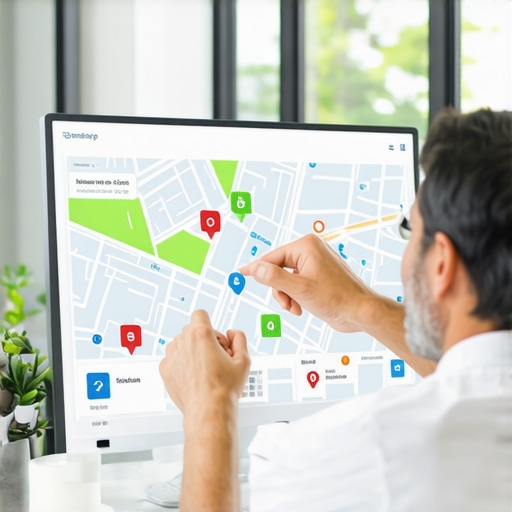
Many firms suffer from “Map Pin Drift” or a lack of hyper-local geo-targeted SEO. They target “Philadelphia Personal Injury Lawyer” but fail to realize that Philadelphia is a collection of dozens of micro-markets. To break out of the parking lot, you need to utilize sophisticated google maps lead tools that allow you to track your rankings on a 13×13 or 15×15 grid at the street level. Seeing a single “average” ranking number for a city is useless; you need to see exactly where your visibility “falls off the cliff.”
Overcoming this requires more than just NAP (Name, Address, Phone) consistency. It requires building “Geo-Relevance” through localized landing pages that mention specific landmarks, neighborhoods, and local transit routes. If you aren’t signaling to Google that your service area extends beyond your physical walls, you are trapped. For a deeper look at this phenomenon, read The Proximity Trap: Why Your Business Only Ranks for People in Your Own Parking Lot.
2. Review Velocity vs. Review Quality
Most law firms believe that reaching a 4.8 or 4.9-star rating is the “finish line” for reviews. They are wrong. In the 2025 landscape, “Review Velocity” – the frequency and recency of your reviews – is significantly more important than your total count. A firm with 500 reviews that hasn’t received a new one in three weeks will often be outranked by a firm with 50 reviews that receives three new ones every week.
Furthermore, Google’s AI (Gemini) is now performing sophisticated sentiment analysis on the text within your reviews. It is looking for “Interaction Signals.” When a client mentions a specific service (e.g., “best car accident attorney in Phoenix”) and then clicks the “Call” or “Directions” button immediately after reading that review, Google receives a high-intensity signal that your profile is fulfilling the user’s intent.
Data shows that these interaction signals are now outweighing raw review counts. It’s no longer about who has the most reviews; it’s about who has the most active and relevant engagement. This explains Why Your Competitor With Fewer Reviews Still Outranks You in the 3-Pack. To stay ahead, law firms must implement automated systems that encourage a steady stream of reviews that include specific keywords related to their practice areas.
3. The 2026 Shift: Interaction Signals and Physical Evidence
As we move toward 2026, the local SEO landscape is shifting from “what you say about yourself” to “what users actually do.” Google is increasingly leveraging data from Bluetooth beacons, AR signals, and “Store Pings” (GPS data from users’ phones) to verify the legitimacy of a business. If your Google Business Profile claims you are a high-volume personal injury firm, but Google sees that only two unique mobile devices (your employees) enter that office every day, your rankings will suffer. Google knows if people are actually visiting your office.
This is the era of “Physical Evidence.” To dominate, you need to provide Google with high-resolution, geo-tagged photos of your office interior, your team in action, and even your signage. These aren’t just for aesthetics; they are data points that prove your physical existence in a world of “ghost offices” and virtual addresses. You should also be looking at “Live Chat Speed” as a ranking factor. Google is now tracking how quickly businesses respond to messages initiated through the GBP interface. Slow response times signal a poor user experience, which leads to a demotion in the 3-Pack.
To audit these advanced signals, savvy marketers are using google business profile seo tools that go beyond basic keyword tracking. They look at “Check-in” signals and how your brand search volume correlates with your map visibility. The future of local search is an ecosystem where your physical reality must match your digital claims. For more on these upcoming changes, see Local SEO Trends 2026 and the Shift Toward Physical Proximity Signals.
Key Interaction Signals for 2026:
- Request for Quote (RFQ) Speed: Responses under 5 minutes are becoming the gold standard.
- Photo Engagement: High click-through rates on your profile photos signal relevance.
- Driving Direction Requests: The number of people who actually initiate navigation to your office.
- Dwell Time: How long a user stays on your GBP before returning to the search results.
4. Common Audit Failures in Legal Profiles
Even the most expensive agencies often miss the “Silent Killers” of local rankings. During a google business profile optimization audit, we frequently find the following errors that keep a firm’s pin “stuck” at the bottom of the pile:
- Category Dilution: Many firms use the generic “Lawyer” or “Law Firm” as their primary category. In competitive markets, you must use the most specific primary category available (e.g., “Personal Injury Attorney” or “Divorce Lawyer”) to capture the highest intent traffic.
- Ghosted Pins: This occurs when Google has “filtered” your profile because it is too close to another firm in the same building or category. If you share a suite with five other personal injury lawyers, Google may only show one of you.
- Website Signal Mismatch: If your GBP points to a generic homepage instead of a localized, practice-specific landing page, you are losing “Relevance” points. The content on the linked page must mirror the services listed on your profile.
- Unanswered Q&A: The “Questions & Answers” section is often neglected. Leaving these unanswered – or worse, allowing a competitor to answer them – is a major red flag for Google’s interaction algorithm.
Fixing these issues can lead to explosive results. We have seen case studies where correcting technical local signals and category alignment resulted in a 357% growth in organic map leads within six months. If your rankings haven’t moved in a year, it’s likely because of one of these hidden errors. You can learn more about these “invisible” obstacles in What Your Automated SEO Audit Missed About Your Stuck Map Pin.
Conclusion: Moving from “Hidden” to “Highly Visible”
The era of “set it and forget it” local SEO is over. The 73% of law firms failing their audits are doing so because they are playing by 2018 rules in a 2026 world. They are prioritizing word counts over interaction signals and backlinks over brand search volume. To dominate the Local 3-Pack, you must bridge the gap between your physical office and your digital presence.
Stop settling for reports that show you ranking #1 for your own name. Demand to see your visibility across the entire city. Focus on increasing your review velocity, responding to leads in under five minutes, and providing Google with the physical evidence it needs to trust your location. Local SEO is no longer a passive marketing channel; it is an active, engagement-driven competition.
If you aren’t sure where your firm stands, I highly recommend using a professional google business profile audit tool to identify your “visibility cliffs.” The firms that adapt to the interaction-heavy, proximity-focused algorithm of 2026 will be the ones that capture the highest-value leads while their competitors remain trapped in their own parking lots. Don’t let your firm be part of the 73% failure rate – take control of your local signals today.